

Equity markets spent much of the third quarter rotating between reasons to be excited and reasons to be nervous, creating several mini boom-and-bust cycles in just three months! It would seem that investor emotional angst is struggling to reconcile with data that supports current stock market levels. By quarter’s end, not much was resolved as most major stock markets ended up slightly positive.
The bond market, however, effectively had unanimous agreement that interest rates are on the rise (thank you nagging and persistent inflation 😡). The Canadian bond market fell back close to 3% on the quarter and the U.S. bond market dropped even further. It is worth mentioning that most of our fixed income exposure is in ETFs that performed much better than the Canadian bond market including corporate bonds, short-term bonds, high yield bonds and preferred equity. This has been a consistent source of value added for Justwealth clients over the years.
Central Banks appear to agree with the bond market. The U.S. Federal Reserve, European Central Bank, Bank of Japan, and the Reserve Bank of Australia all raised their benchmark interest rates in the third quarter. Not one major Central Bank lowered rates during the same time period. At the same time, the enormous and growing levels of sovereign debt are renewing concerns about governments’ ability to service their debt in a responsible manner, putting even more upward pressure on global sovereign bonds to the point of some observers calling it a “Global Bond Selloff”.
The bond market behaves much more sensibly than the stock market. Bond prices are mathematically priced almost entirely based on interest rates. Stocks on the other hand, are far more of an art than a science, at least in the short run. Stocks incorporate far more speculation in pricing based on demand, trends, and ultimately profitability – and the range of speculation can be extremely significant. Opinions can, and will, change quickly and wildly, potentially leading to very large price swings. That just doesn’t happen with bonds and that is why bonds should have a place in most people’s portfolios as the stabilizing component.
At the moment, the trend-du-jour is a bit of a panic that AI may be overvalued. We’ll see how long this trend lasts, typically measured in days, weeks or months, and then it is on to the next media-induced hype-a-thon. To put everyone’s mind at ease, there is almost ZERO AI stock-related exposure in the Canadian stock market – and not much more for developed markets in Europe. Two of the world’s largest AI companies (Open AI and Anthropic) are still private. There is some exposure via companies like NVIDIA, Google, or other tech names, but they represent a very small fraction of any Justwealth portfolio. Nothing to see here, move along….
U.S. mid-term elections are now only a few weeks away. While the position of President is not up for election, the amount of power that the governing Republican party (and President) currently have, is at stake. Losing majority control in either the House or Senate would result in gridlock, which makes it much more difficult for the government to “get things done”. It is hard to predict how the outcome will impact the markets, other than it will likely increase short-term volatility. Like any event of this perceived importance, immediate market impacts may be experienced, but they will very likely be forgotten and effectively made irrelevant very quickly.
One of the things that we do for clients in every fourth quarter of the year is to evaluate the potential for tax-loss harvesting for those who are invested in non-registered accounts. Similar to the past couple of years, it may be difficult to find many material opportunities this year given the overall positive equity market returns, but if we are able to find some, we will be contacting clients automatically before taking any actions.
Here is a recap of market performance as of September 30, 2026*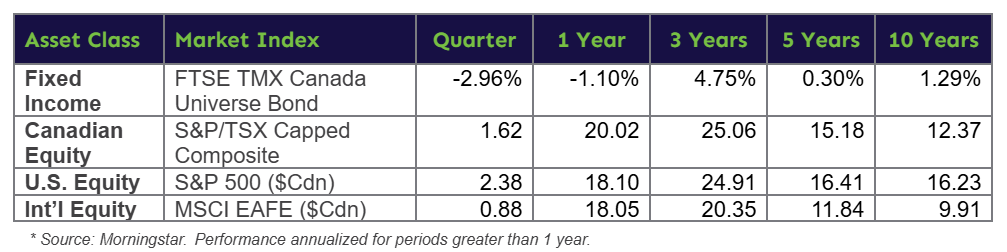
Comments are closed.